








How to calculate the LED consumption of a strip
Whether you're designing lighting for an industrial warehouse, sizing the electrical system for a boutique hotel, or evaluating a retrofit for a chain of stores, it is important to know how to calculate LED strip consumption and understand the precise energy consumption of light sources. This represents the essential starting point for any project. Yet, in our experience, this step is too often approximated, with direct consequences on power supply selection, actual savings on electricity bills, and above all (in the worst cases) on system safety.
This article stems from the practical need to provide electricians and designers with a rigorous calculation tool, complete with formulas, comparative tables, and operational guidelines. The data reported here is based on laboratory measurements and values declared by leading manufacturers of LED strips and power supply components.
Why correctly calculating LED consumption matters
The issue is not the complexity of the formula (which, as we will see later, is very simple) but the limited knowledge of the actual technical parameters of installed products. Understanding the difference between nominal watts, absorbed watts, and dissipated watts is not a detail to overlook: it is the foundation upon which a properly sized system is built—one that lasts over time and delivers the savings promised to the client. But let's proceed step by step.
How do light bulbs and LED strips work?
The LED (light emitting diode) is a semiconductor device that converts electrical energy into light through electroluminescence. Unlike an incandescent bulb, which produces light by heating a filament to temperatures of approximately 2,700°C, dissipating about 90% of energy as heat, the LED concentrates nearly all energy into producing visible photons.
The luminous efficacy of a professional-quality LED today ranges between 130 and 220 lm/W (lumens per watt), compared to 10–15 lm/W for a classic incandescent bulb. This ratio, called luminous efficacy, is the fundamental data point for understanding why LEDs consume so little for the same amount of luminous flux delivered.
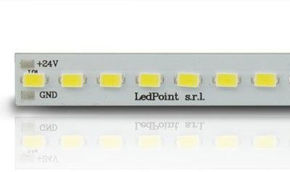
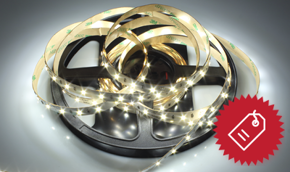
In LED strips, the structure consists of a flexible PCB tape on which LED chips (typically SMD 2835, SMD 5050, or COB) are soldered at regular intervals. The total consumption of the strip depends on three closely related variables:
- unit power of the single chip (expressed in watts);
- chip density (number of LEDs per linear meter);
- total length of the installation.
Understanding this structure is essential to avoid the very common mistake of estimating LED strip consumption based solely on the power supply label rather than on the technical specifications of the tape.
The consumption formula: watts, amperes, and kilowatt-hours
The starting point for any energy calculation is Joule's law, in its most elementary form applied to direct current circuits:
Where: P = Power [W] | V = Voltage [V] | I = Current [A]
For a 24V LED strip with a current draw of 1.5 A per meter, the absorbed power per linear meter will be:
To calculate energy consumption in kilowatt-hours (kWh), the unit used on electricity bills, use the formula:
Practical example: a 10 W/m LED strip over 5 meters of length, turned on for 8 hours per day:
E_daily = 50 W × 8 h / 1000 = 0.4 kWh/day
E_annual = 0.4 × 365 = 146 kWh/year
With an average electricity cost in Italy of approximately €0.30/kWh (Eurostat 2024 data, residential and small business users), the annual cost of this installation will be:
How much do LEDs consume? A quick comparison
One of the most frequent questions I receive from purchasing managers and business owners is: "Do LEDs or traditional bulbs consume more?" The answer is unequivocal, and the following figures demonstrate this definitively.
Comparison of lighting technologies: efficiency and consumption
| Technology | Luminous flux | Power absorbed | Efficacy (lm/W) | Average lifespan (hours) | Heat emitted |
|---|---|---|---|---|---|
| Incandescent | 800 lm | 60 W | 13 lm/W | 1,000 | Very high (~90%) |
| Halogen | 800 lm | 42 W | 19 lm/W | 2,000 | High (~85%) |
| Compact Fluorescent (CFL) | 800 lm | 14 W | 57 lm/W | 8,000 | Medium (~30%) |
| Standard LED | 800 lm | 8 W | 100 lm/W | 25,000 | Low (~15%) |
| Professional LED (high efficiency) | 800 lm | 5 W | 160 lm/W | 50,000+ | Very low |
Hourly consumption calculation for common power ratings
| LED bulb power | Incandescent equivalent | kWh in 1 hour | kWh in 8 hours | kWh in 1 year (8h/day) | Annual cost (€0.30/kWh) |
|---|---|---|---|---|---|
| 4 W | ~40 W | 0.004 | 0.032 | 11.7 | €3.50 |
| 6 W | ~60 W | 0.006 | 0.048 | 17.5 | €5.25 |
| 9 W | ~75 W | 0.009 | 0.072 | 26.3 | €7.88 |
| 10 W | ~100 W | 0.010 | 0.080 | 29.2 | €8.76 |
| 15 W | ~150 W | 0.015 | 0.120 | 43.8 | €13.14 |
| 20 W | ~200 W | 0.020 | 0.160 | 58.4 | €17.52 |
Energy savings comparison: incandescent vs. LED (50-light installation)
| Scenario | Total power | kWh/year (10h/day) | Annual cost | Savings vs. incandescent |
|---|---|---|---|---|
| 50 × 60W incandescent bulbs | 3,000 W | 10,950 | €3,285 | — |
| 50 × 14W CFL | 700 W | 2,555 | €766 | €2,519/year |
| 50 × 6W LED | 300 W | 1,095 | €328 | €2,957/year |
| 50 × 5W professional LED | 250 W | 912 | €274 | €3,011/year |
Specific calculation for LED strips
Calculating LED strip consumption follows the same logic described above, with one crucial additional variable: linear power, expressed in W/m. This data is reported on the product datasheet and varies significantly based on technology, chip density, and build quality.
Complete formula for calculating LED strip consumption
E [kWh/day] = P_total × operating hours / 1000
Cost [€/year] = E_daily × 365 × tariff_€/kWh
LED strip consumption table by type and power
| Strip type | Chip | LEDs/m | W/m | Voltage | Lm/m (typical) | Typical application |
|---|---|---|---|---|---|---|
| Standard low-power strip | SMD 2835 | 60 | 4.8 | 12V | 450 | Decorative lighting |
| Medium-density strip | SMD 2835 | 120 | 9.6 | 24V | 960 | Backlighting, furniture |
| High-density strip | SMD 2835 | 240 | 19.2 | 24V | 1,920 | Functional lighting |
| Standard COB strip | COB | — | 10 | 24V | 1,100 | Cove lighting, profiles |
| High-efficiency COB strip | COB | — | 14 | 24V | 1,680 | General lighting |
| RGB strip (color) | SMD 5050 | 60 | 14.4 | 12V | ~600 (white) | Chromatic effects, accent |
| Professional RGBW strip | SMD 5050 | 60 | 19.2 | 24V | ~800 (white) | Architecture, hospitality |
| High-power pro strip | SMD 3030 | 70 | 30 | 24V | 3,000+ | Industrial, retail, museum |
Complete calculation example for a professional installation
Scenario: indirect lighting for an open-plan office, perimeter 24 meters, 14W/m COB LED strip at 24V, average operation 10 hours/day, 250 working days/year.
E_daily = 336 W × 10 h / 1000 = 3.36 kWh/day
E_annual = 3.36 × 250 = 840 kWh/year
Annual cost = 840 × 0.30 = €252/year
For comparison, the same perimeter lit with 36W T8 fluorescent tubes (one tube every 1.2 m = 20 fixtures × 36W = 720W nominal, but with electromagnetic ballasts the actual draw rises to ~800W):
Annual fluorescent cost = 2,000 × 0.30 = €600/year
Savings with LED: €348/year (−58%)
The safety margin
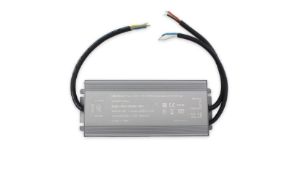
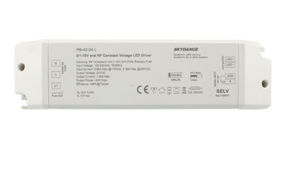
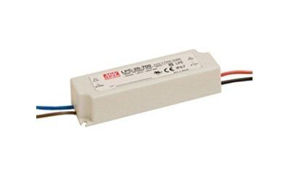
One of the most common errors I observe in quotes from less experienced installers is sizing the power supply at the limit, i.e., with a nominal power exactly equal to the calculated consumption of the strips. This practice, seemingly economical, is technically incorrect and generates real-world problems.
The reason is simple: LED power supplies operate optimally and guarantee maximum efficiency and lifespan when working at no more than 80% of their nominal power. Running them constantly at 100% means:
- increased internal temperature, consequently reducing useful life;
- activation of thermal protections in warm environments, causing sudden shutdowns;
- accelerated degradation of internal electrolytic capacitors;
- risk of overload in case of inrush current peaks at startup.
The 20% rule: how to apply it?
Example: 336W strip → P_power_supply ≥ 420W
Power supply selection table with 20% margin
| Calculated strip consumption | Minimum power supply (÷0.80) | Recommended commercial size | Recommended Mean Well power supply |
|---|---|---|---|
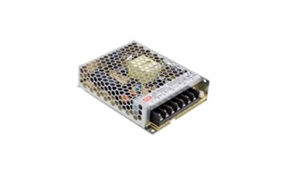
| up to 40W | 50W | 60W | HLG-60H-24 |
| 41 – 80W | 100W | 100W | HLG-100H-24 |
| 81 – 120W | 150W | 150W | HLG-150H-24 |
| 121 – 200W | 250W | 240W | HLG-240H-24 |
| 201 – 320W | 400W | 320W / 480W | HLG-320H-24 / HLG-480H-24 |
| 321 – 400W | 500W | 480W | HLG-480H-24 |
| 401 – 600W | 750W | 600W | 2× HLG-320H-24 |
How much does it cost to keep an LED on?
A question I often receive from purchasing managers and business owners is: "How much does an LED cost if left on continuously? And a 10W spotlight left on all day?". The precise answer requires only a multiplication, but it is useful to have a quick reference table.
Hourly and daily cost for various LED power ratings (tariff: €0.30/kWh)
| LED power | Cost 1 hour | Cost 8 hours/day | Cost 24 hours/day | Monthly cost (8h/day) | Annual cost (8h/day) |
|---|---|---|---|---|---|
| 5 W | €0.0015 | €0.012 | €0.036 | €0.36 | €4.38 |
| 7 W | €0.0021 | €0.017 | €0.050 | €0.50 | €6.13 |
| 10 W | €0.003 | €0.024 | €0.072 | €0.72 | €8.76 |
| 20 W | €0.006 | €0.048 | €0.144 | €1.44 | €17.52 |
| 50 W | €0.015 | €0.120 | €0.360 | €3.60 | €43.80 |
| 100 W | €0.030 | €0.240 | €0.720 | €7.20 | €87.60 |
As clearly shown in the table, a 10W LED spotlight left on for 8 hours per day costs less than 1 cent per hour and approximately €8.76 per year—a figure that clearly demonstrates the economic insignificance of the consumption of individual LED luminaires compared to the past.
Why does the LED remain slightly on when I turn it off?
This phenomenon, known as ghosting or residual light, is one of the most frequently reported issues by installers and generates justified concern regarding consumption. It is therefore useful to analyze its causes precisely.
An LED remains weakly illuminated even when switched off primarily for three reasons:
- leakage current through the switch: some switches, particularly those with an integrated indicator light, allow a small current to pass even in the "open" position (typically 0.5–1 mA). This micro-current is sufficient to power an LED in dimmable mode or with a high-sensitivity driver;
- incompatible dimmer: TRIAC dimmers designed for resistive loads (incandescent bulbs) do not correctly cut current at the low load levels typical of LEDs, generating residual current even at logical zero;
- parasitic cable capacitance: in installations with very long cables, the distributed capacitance of the cable can accumulate enough charge to keep a low-consumption LED illuminated.
How much energy is saved with LEDs?
The energy efficiency of LEDs is documented by data from leading international organizations. Below are the most significant references.
- According to the International Energy Agency (IEA), in 2023 LEDs already represented 54% of all light sources installed globally, and it is estimated that by 2030 their contribution to reducing CO₂ emissions related to lighting will exceed 40%;
- ENEA estimates that a complete transition to LED lighting in Italian public buildings could generate savings of approximately 4 TWh/year, equivalent to the annual consumption of about 1.3 million Italian households;
- A study conducted on a sample of 120 Italian retail companies found that retrofitting lighting with LEDs reduced lighting consumption by an average of 67%, with an average payback period of 2.8 years;
- The European Parliament, with Regulation (EU) 2019/2020, has definitively removed filament bulbs and non-directional halogen lamps from the European market, establishing LED as the only technology permitted for domestic and commercial use.
Energy savings and payback table for LED retrofits in commercial settings
| Installation type | Pre-LED consumption (kWh/year) | Post-LED consumption (kWh/year) | Energy savings | Economic savings/year | Estimated payback |
|---|---|---|---|---|---|
| 100 sqm store (50 halogen spotlights) | 5,475 | 1,460 | 73% | €1,204 | 1.5–2 years |
| 300 sqm open-plan office (fluorescent tubes) | 8,760 | 3,504 | 60% | €1,577 | 2–3 years |
| 50-room hotel (mixed lamps) | 21,900 | 6,570 | 70% | €4,599 | 2.5–4 years |
| 1,000 sqm industrial warehouse (HID/vapor lamps) | 43,800 | 13,140 | 70% | €9,198 | 3–5 years |
Which LEDs consume the least?
To the question "which LED bulbs consume the least?" it is possible to give an answer, albeit somewhat nuanced: there is no single "best overall" LED, but the most efficient technology varies based on the specific application. Here are the technical criteria we suggest for guiding customer choices.
Parameter 1: luminous efficacy (lm/W)
This is the fundamental parameter. For the same lumens produced, the higher the lm/W value, the lower the consumption. Professional high-efficiency LEDs available today reach 160–220 lm/W. Be wary of products claiming efficacy above 200 lm/W without third-party certifications (TÜV, SGS, Intertek).
Parameter 2: LED chip
- SMD 2835: excellent efficiency/cost ratio, ideal for LED strips and ceiling lights;
- SMD 3030: high power, for professional spotlights and industrial lighting;
- COB (Chip on Board): maximum luminous density, uniform light, ideal for high-output strips;
- CSP (Chip Scale Package): extreme miniaturization, very high efficiency, the future of the premium segment.
Parameter 3: integrated driver/power supply
In LED bulb lamps, the integrated driver has its own efficiency that affects actual consumption. A quality driver has a Power Factor > 0.9 and efficiency > 85%. Low-quality products may have PF below 0.5, with absorption of undeclared reactive current that does not appear on the bill but affects system sizing.
Which consumes more, an LED strip or a bulb?
The answer depends on the specific configuration, but generally a 10W LED bulb delivers about 1,000 lm over 360°. A 10W/m LED strip over one linear meter delivers 900–1,100 lm over 120° (directional light). Consumption per meter is comparable, but the strip distributes light over a linear surface, making it more suitable for indirect lighting and ambient illumination.
FAQ
Now let's look at some of the questions we are often asked when discussing energy savings and consumption.
Exactly 0.01 kWh. In 8 hours: 0.08 kWh. In one year with 8 hours/day usage: 29.2 kWh, equal to approximately €8.76 (at €0.30/kWh).
An "equivalent 100W" LED has an actual power of approximately 10–12W. Consumption is therefore 0.010–0.012 kWh/hour: about 90% less than the original.
Under normal conditions, consumption when switched off is zero. In the presence of ghosting (see section 8), residual current is on the order of 0.1–0.5 W, practically negligible.
P_total = 100W. E_annual = 100W × 8h × 365d / 1000 = 292 kWh/year. Cost: approximately €87.60 (at €0.30/kWh).
Among technologies available on the mass market, high-efficiency LEDs with efficacy >160 lm/W are the light sources with the lowest consumption. OLED LEDs are efficient but have costs and lm/W still not competitive for general professional use.
Because they convert almost all electrical energy into light (photons) rather than heat. The electroluminescence process in the semiconductor is intrinsically more efficient than light generation through incandescence or gas excitation.
LED consumption: why calculating it matters
Precise calculation of LED strip and LED bulb consumption is an indispensable technical skill for anyone working professionally in the lighting, electrical installation, or architectural design sectors. The key points to remember are:
- the basic formula is simple (P [W] = V × I) but applying it correctly requires knowing the actual product data, not marketing estimates;
- the 20% safety margin on the power supply is not a recommendation: it is a technical requirement to guarantee system longevity, efficiency, and safety;
- LEDs consume on average between 60% and 90% less than the technologies they replace, with commercial payback periods that rarely exceed 3 years;
- choosing the right LED depends on efficacy in lm/W, chip type, driver quality, and the IP protection rating required by the installation environment;
- the phenomenon of residual light (ghosting) has negligible impact on actual consumption but should be eliminated for proper installation practice.
For any sizing, component selection, or technical verification needs, the Ledpoint.it team is available to support professionals, electricians, and companies in choosing the LED lighting solutions best suited to every application. Find our contact details on the following page: Ledpoint S.r.l. | Contacts