






Led track lighting: a complete guide
Track lighting is one of the most demanding challenges in the entire field of led lighting system design: a karting circuit, an athletics track, a velodrome, or a motor racing circuit are not simple surfaces to illuminate, they are dynamic environments where athlete speed, safety during competition, visibility for judges and spectators, and television broadcast quality impose precise technical requirements, codified by the UNI EN 12193:2019 standard and CONI guidelines.
In this in-depth technical guide, we will analyze all the lighting parameters necessary to properly design an LED system for sports racing tracks, from selecting the appropriate illuminance value in lux to ensuring uniform light distribution, from controlling driver glare to choosing LED strips for perimeter and signage applications, evaluating the most technically appropriate solutions for each type of facility.
Track lighting: specificities and complexity of lighting systems
The term track lighting, in the context of sports facilities and structures dedicated to races and competitions, refers to the set of artificial lighting systems designed to ensure optimal visual conditions on surfaces traversed at high speed by athletes, cyclists, drivers, or motor vehicles. This is a distinct technical domain compared to lighting for static sports fields: the speed of movement of competing subjects introduces photometric and perceptual variables not found in any other sporting context, requiring specific and non-negotiable design criteria.
A go-kart driver navigating a curve at 60 km/h, a sprinter covering 100 meters in under 10 seconds, a track cyclist reaching 70 km/h during a launch: all these athletes depend on lighting to process in real time the track geometry ahead, identify braking points, assess distance from opponents, and react to unexpected situations. Insufficient, non-uniform, or glaring lighting in these contexts is not merely a matter of visual comfort: it is a direct safety issue. Designing an LED system for sports tracks therefore means simultaneously addressing requirements for visual performance, athlete safety, television broadcast quality, energy consumption containment, and compliance with current regulations.
Variables to consider in track lighting
Compared to lighting for any other sports facility, racing and competition tracks present unique variables that designers must consider from the earliest study phases:
- Subject speed: athletes and vehicles move at speeds from 10 to over 200 km/h, requiring extremely rapid visual adaptation times and highly uniform light distribution to avoid temporary blindness phenomena during light-shadow transitions;
- Track geometry: straights, curves, chicanes, and variants create zones with very different viewing angles relative to light sources, increasing the risk of direct glare in the racing lane;
- Track continuity: unlike a soccer or tennis court, the track is a closed or linear path of variable length (from 200 m for an indoor athletics track to over 5 km for a motor racing circuit) requiring lighting solutions distributed along the entire length;
- High-speed television broadcasts: slow-motion and high-frame-rate cameras used in race coverage are particularly sensitive to flicker from artificial lighting; a non-flicker-free LED system can render video footage unusable;
- Coexistence of zones with different requirements: the track itself, grandstands, pit areas, paddocks, safety routes, and pit-lane zones have vastly different illuminance requirements that must be managed in an integrated and coherent manner.
Market data: the growth of led lighting in sports facilities
The global market for led lighting in sports facilities is experiencing strong growth, driven by the need for energy retrofitting of facilities built with traditional technologies (high-pressure sodium, metal halides, halogen lamps) and the increasing availability of high-efficiency led solutions capable of achieving efficiencies exceeding 150 lm/W even at the high power levels required for sports lighting. The transition to led typically enables energy savings between 40% and 70% compared to traditional sources, with payback periods often under 3-5 years, also thanks to maintenance benefits (useful life >50,000 hours versus 10,000-15,000 hours for metal halides).
In Italy, the CONI guidelines for sports facilities, last updated in 2008 but expressly referencing the UNI EN 12193:2019 standard for lighting specifications, are driving an increasing number of sports organizations, municipalities, and private facility operators toward led retrofitting of existing facilities, with particular attention to athletics tracks, velodromes, and indoor karting circuits.
Reference regulations: UNI EN 12193, CONI, and sports federations
Designing an led track lighting system cannot proceed without precise knowledge of the current regulatory framework. In Italy, as throughout Europe, clear and binding technical references define minimum requirements for each discipline and competition level. Non-compliance prevents facility certification for official competitions and may entail liability in case of injuries related to insufficient visibility conditions.
The UNI EN 12193:2019 standard
The UNI EN 12193:2019 standard, also known as DIN EN 12193, is the primary reference document for artificial lighting of indoor and outdoor sports installations, at both amateur and professional levels. It provides illumination values for the design and verification of sports facility lighting in terms of illuminance, uniformity, glare limitation, and color properties of light sources. All requirements are intended as minimums: the standard also specifies measurement methods and limitations on luminaire positioning for glare control.
The standard introduces three lighting classes corresponding to different facility usage levels:
| Class | Competition level | Spectator type | Notes |
|---|---|---|---|
| Class I | Top-level tournaments and training, international competitions | Long viewing distances, television broadcasts | Higher requirements, often with additional prescriptions from international federations |
| Class II | Mid-level tournaments and training, national competitions | Medium viewing distances | Intermediate requirements, standard for regional and national competition facilities |
| Class III | Simple tournaments (mostly without spectators), training, amateur sports | Absence or proximity to athletes | Minimum requirements, standard for local, school, recreational-use facilities |
CONI guidelines
The CONI standards for sports facilities provide more general guidance on artificial lighting for facilities, expressly referencing the UNI EN 12193 standard for detailed lighting specifications. CONI particularly recommends avoiding glare for participants and competition judges, and establishes that, if verification against UNI values is not performed, light sources must not be visible within the activity space at an angle less than 20° relative to the horizontal (measured at 1.5 m from ground level).
Sports federation prescriptions
For disciplines with official certified competitions, individual national and international sports federations may establish requirements more restrictive than regulatory minimums. In particular:
- FIDAL (Italian Athletics Federation): for athletics track certification for official competitions, lighting requirements vary depending on facility level (regional, national, international);
- FCI (Italian Cycling Federation): velodromes certified for national and international competitions must meet specific illuminance and uniformity requirements ensuring adequate visibility conditions for the speeds reached by track cyclists;
- ACI Sport / FIA: motor racing circuits and karting tracks certified for official competitions must meet illuminance, uniformity, and anti-glare requirements defined by the federation, with particular attention to start/finish zones, pit-lanes, and key track sectors.
Compliance with sports federation prescriptions is a necessary condition for facility certification and for organizing official competitive events. Before initiating LED track lighting design for competition circuits, it is always advisable to verify the specific requirements of the relevant federation and to engage a qualified lighting designer alongside the photometric design process.
Electrical regulations: CEI 64-8 and environment classification
On the electrical side, installation of led lighting systems for sports tracks must comply with the CEI 64-8 standard for electrical installations, with particular attention to environment classification (indoor/outdoor, presence of humidity, dust, mechanical risk), selection of IP protection ratings for components, differential protection, and proper sizing of power cables based on line lengths and installed power.
Lux values by discipline: athletics, cycling, karting, motorsport
The fundamental parameter of any track lighting project is the average horizontal illuminance value (Ēm) expressed in lux. The UNI EN 12193:2019 standard and CONI guidelines establish minimum values for each discipline and lighting class. Knowing these values and applying them correctly to the specific context is the mandatory starting point for any professional design.
Illuminance values table by track discipline
| Discipline / Facility | Class III — min. lux | Class II — min. lux | Class I — min. lux | Min. CRI (Ra) |
|---|---|---|---|---|
| Athletics, track | 75 | 200 | 500 | 65 (80 for TV) |
| Track cycling (velodrome) | 200 | 500 | 750 | 65 (80 for TV) |
| Go-kart / Karting (recreational/competitive use) | 100–200 | 300–500 | 500–750 | 65–80 |
| Motorsport / Racing circuit (indoor track) | 200 | 500 | 750–1,000 | 80 |
| Cycle-pedestrian path (mixed use) | 10–15 (UNI 11248 standard cat. S) | 30–50 | — | Ra ≥ 60 |
| Ice skating rink | 200 | 500 | 750 | 65 |
Indicative values based on UNI EN 12193:2019 and CONI guidelines. For facilities with television broadcasts, Class I values may be significantly higher due to vertical illuminance requirements and broadcaster broadcast specifications.
Athletics: outdoor and indoor tracks
An athletics track is typically an oval track with eight 1.22 m lanes, with a perimeter of 400 m (standard outdoor track) or 200 m (indoor track). The discipline's photometric requirements are determined by two main needs: visibility of lane lines and ground markings for running athletes, and visibility of athlete positions for judges, referees, and spectators in the stands.
For a Class III athletics track (amateur use, training, local events), the minimum value of 75 lux provides acceptable but not optimal visibility conditions. For Class II events (regional and national championships), the average 200 lux is the standard ensuring good perception of race positions even on outer lanes. For Class I facilities with television broadcasts, 500 lux is the minimum value on the horizontal plane, but broadcast cameras typically also require adequate values on the vertical plane (vertical illuminance), necessitating much more sophisticated design with light sources positioned from multiple directions.
Track cycling: the velodrome
The velodrome, in both outdoor and indoor configurations, is one of the most demanding facilities from a track lighting perspective. The speeds reached by track cyclists (up to 70 km/h and beyond during launches) make lighting uniformity an absolute requirement: even a small shadowed area or discontinuity in lux level can cause a cyclist to lose orientation on banked curves, with potentially very serious consequences. The standard prescribes uniformity Uo ≥ 0.5 (ratio of minimum to average illuminance) even for Class III, with increasing values for higher classes.
CRI is particularly important in indoor velodromes: insufficient color rendering makes it difficult to read the polycarbonate or wooden track surface, with reflections and altered depth perceptions that can disorient cyclists on curves. For indoor velodromes with official competitions, Ra ≥ 80 is recommended.
Karting: indoor and outdoor tracks
Go-kart tracks represent one of the most frequent track lighting contexts in the recreational and amateur segment. Medium-sized indoor tracks (1,000-2,000 m²) require a system ensuring uniform horizontal illuminance between 100 and 200 lux on the ground, with variation between minimum and maximum values under 10% across the entire track length. This uniformity is fundamental for driver safety, often involving inexperienced participants who must precisely evaluate distances and trajectories in curves.
Specific challenges of indoor karting track lighting include: managing light in zones with obstacles (pylons, guardrails, lane delimiters) that create localized shadow zones, controlling driver glare on straight sections where gaze is directed toward frontal projectors, managing heat generated by the system in enclosed spaces with poor ventilation, and the need for autonomous emergency solutions ensuring minimum illuminance levels in case of main power interruption.
Motorsport: circuits and racing tracks
Lighting for motor racing circuits and motorsport tracks is the most demanding context in the entire track lighting sector. High speeds, drivers wearing helmets and visors (which reduce field of view and peripheral sensitivity), need to read safety light signals while in motion, television broadcasts with high-definition and slow-motion cameras: all these factors combine to create one of the most challenging frameworks of photometric, chromatic, and technological requirements in the lighting profession.
For circuits with official Class I competitions, horizontal illuminance values exceeding 750-1,000 lux with uniformity Uo ≥ 0.6, CRI Ra ≥ 80, and dynamic lighting level management capabilities to adapt to different race phases (starting grid, Safety Car, red flag conditions) are commonly required. DALI or DMX control systems become fundamental components of the installation here.
Lighting uniformity: the critical parameter on tracks
If the absolute lux value defines whether the system illuminates enough, uniformity determines whether it illuminates well. On a racing track, lighting uniformity is often more critical than the average illuminance value: a driver navigating a curve at 60 km/h passing from 300 lux to 50 lux in a few meters experiences a visual perturbation comparable to emerging from darkness toward an intense light source, a temporary loss of vision which, on tracks, translates into loss of control.
Uniformity parameters in UNI EN 12193 standard
The UNI EN 12193 standard defines two uniformity parameters:
- general uniformity (Uo): ratio of minimum illuminance to average illuminance on the reference surface (E min / E average). A value of 0.5 indicates that no point on the surface measures less than half the average value;
- adjacent uniformity (Ug) or extreme uniformity ratio: ratio of minimum to maximum illuminance (E min / E max). Less commonly used in current standards but significant for evaluating local contrasts.
| Discipline | Class III — min. Uo | Class II — min. Uo | Class I — min. Uo |
|---|---|---|---|
| Athletics, track | 0.40 | 0.50 | 0.60 |
| Track cycling | 0.50 | 0.60 | 0.70 |
| Karting (indicative) | 0.50 | 0.60 | 0.70 |
| Motorsport (circuits) | 0.50 | 0.60 | 0.70 |
How to achieve good uniformity on long tracks
Achieving good uniformity values on tracks longer than 300-400 m is one of the main challenges in photometric design for these facilities. The primary strategies adopted by professional designers include: regular distribution of light points along the entire track perimeter with calibrated spacing based on projector mounting height, use of projectors with asymmetric optics enabling optimal light flux distribution on the surface without excessive overlaps, photometric calculation with dedicated software (DIALux, Relux) to verify uniformity across the entire calculation grid before implementation, and integration of supplementary sources (perimeter led strips, led bars on guardrails) to compensate for localized shadow zones in curves or under grandstands.
Glare on tracks: GR, UGR, and driver safety
Glare is one of the most serious problems in track lighting and one of the most common errors in older-generation systems implemented with traditional sources positioned without sufficient attention to the viewing angle of competing athletes. A projector that glares a driver on track not only reduces their performance but constitutes a direct hazard: disabling glare can cause temporary vision loss for fractions of a second, sufficient at certain speeds to make safe braking or trajectory changes impossible.
GR: glare rating for outdoor facilities
For outdoor sports facilities, the UNI EN 12193 standard uses the GR (Glare Rating) index to quantify perceived glare. GR ranges from 10 (no glare) to 90 (unbearable glare). Acceptable limit values vary depending on discipline and lighting class: for athletics and cycling in Class I, GR ≤ 50 is required, while for lower classes values up to 55 are permitted.
UGR: unified glare rating for indoor facilities
For indoor facilities (velodromes, indoor karting tracks, skating rinks), the reference parameter for glare is the UGR (Unified Glare Rating), calculated according to formulas in the EN 13201 standard. The EN 12464-1 standard for indoor workplace lighting, also applicable to indoor sports facilities, sets UGR limit values depending on activity type and prevailing viewing direction.
Specific glare issues on racing tracks
On racing tracks, the glare problem assumes specific characteristics requiring dedicated design solutions. On circular or oval tracks (velodromes, athletics tracks), the driver or athlete at any point on the course looks in a different direction relative to light sources, meaning projector positioning must be designed to ensure that the angle of incidence relative to direction of travel never falls below 20-25° relative to horizontal, the minimum threshold to avoid direct glare.
On linear tracks with long straights (such as athletics tracks for 100 and 200 meters), the problem is greatest during the acceleration phase: the athlete looks straight ahead and projectors positioned at the end of the straight are exactly in their line of sight. In these cases it is essential to position projectors laterally relative to the track, not frontally, with narrow optics directing flux downward and not toward athletes' eyes.
On karting tracks and indoor racing circuits, curves are critical points: in curves the driver tilts their head and the field of view changes rapidly, increasing the risk of momentarily fixating on a source that would not have been glaring on a straight. Projectors in curve zones must be positioned with particular care, favoring elevated mounting angles (heights ≥ 6-8 m) and optics with asymmetric distribution.
Why led is the right choice for sports tracks
Led technology has completely redefined the possibilities of sports lighting, making possible what was impractical or economically unsustainable with traditional sources. For racing tracks, led advantages over high-pressure sodium and metal halides are particularly significant across multiple dimensions: energy efficiency, light quality, control, maintenance, and design flexibility.
Energy efficiency: from 80 lm/w to over 150 lm/w
Professional led projectors for sports facilities now achieve efficiencies exceeding 150 lm/W, compared to 70-100 lm/W for metal halides and 40-70 lm/W for high-pressure sodium. This means that for the same illuminance level on track, an led system requires installed electrical power 2 to 3 times lower than previous technologies, with energy savings translating into significant operational cost reduction over time.
Instant start-up and native dimming
One of the most practical operational advantages of led in sports facilities is instant start-up even when hot: metal halide projectors require up to 5-10 minutes to reach full power after start-up, and cannot be restarted immediately after shutdown. Led starts instantly at full power, both from initial start-up and after an interruption, with enormous management advantages in evening competitions where start-up delays would be unacceptable.
Native dimming of led systems, through dimmable drivers and DALI, DMX, or 0-10V control systems, enables real-time variation of system light intensity, adapting lux levels to different event phases (practice, race, award ceremony, emergency) without replacing fixtures or modifying the installation.
Light quality: flicker-free for television broadcasts
The quality of light produced by led systems is superior to that of traditional sources in all parameters relevant to sports lighting: high CRI (Ra ≥ 80 easily achievable), stable color temperature over time, and above all absence of flicker with certified quality power supply systems. Flicker is the most critical parameter for television broadcasts of fast sporting events: even flicker with frequency above the threshold of human eye perception (>50 Hz) can be detected by high-speed cameras and produce visible pulsation effects in video. Professional led systems with Mean Well or equivalent high-frequency PWM drivers completely eliminate this problem.
Useful life and maintenance: over 50,000 hours
The useful life of led components is far superior to that of any traditional source: a quality led strip maintains 70% of initial flux (L70) for over 50,000 hours of operation, which corresponds, with 8 hours of daily use, to nearly 17 years of service. For a track installation mounted on poles or towers at heights of 10-20 m, the maintenance advantage is enormous: replacing a traditional lamp at 15 m height requires an aerial platform operation costing several hundred euros, to be repeated every 1-2 years. With led this operation becomes necessary, under equal conditions, only once over a 15-20 year period.
| Parameter | Professional led | Metal halides | High-pressure sodium |
|---|---|---|---|
| Luminous efficiency (lm/W) | 130–160 | 70–100 | 70–120 |
| Useful life (L70) | >50,000 h | 10,000–15,000 h | 15,000–20,000 h |
| Start-up to full power | Instant | 5–10 minutes | 3–5 minutes |
| Native dimming | Yes (0–100%) | No | Limited |
| Typical CRI | Ra 70–90+ | Ra 65–90 | Ra 25–60 |
| Flicker on TV broadcasts | Absent (quality) | Present (100 Hz) | Present (100 Hz) |
| Energy savings vs. metal halides | 40–60% | — | — |
Led floodlight projectors: sizing and positioning for tracks
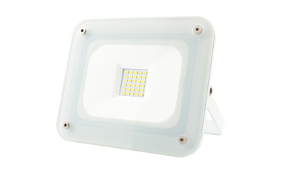
The primary lighting of a sports racing track is almost always achieved with high-power led floodlight projectors mounted on poles, towers, or tower structures. These projectors are the heart of the system and their selection (in terms of power, efficiency, photometric distribution, and protection rating) determines the overall quality of the lighting system.
Reference powers and installation heights
The power of floodlight projectors to install and the optimal height of support poles are closely correlated parameters that must be calculated case-by-case with photometric simulations. As an indicative reference for different types of track facilities:
| Track type | Competition level | Indicative projector power | Recommended pole height | Target lux |
|---|---|---|---|---|
| Outdoor athletics track | Amateur / Class III | 200–400W per projector | 10–12 m | 75–100 lux |
| Outdoor athletics track | National competitions / Class II | 400–600W per projector | 12–16 m | 200–300 lux |
| Outdoor athletics track | International competitions + TV / Class I | 600–900W per projector | 16–22 m | 500+ lux |
| Indoor karting | Recreational / Amateur | 100–200W per projector | 6–8 m | 100–200 lux |
| Indoor karting | Competitive | 200–400W per projector | 8–10 m | 300–500 lux |
| Indoor velodrome | National competitions / Class II | 400–600W per projector | 8–14 m | 500–750 lux |
Asymmetric vs. symmetric optics
The photometric distribution of the projector, defined by its optics, is one of the factors most influencing lighting quality on track. Asymmetric optics direct light flux predominantly in one direction, enabling uniform illumination of the track surface from a lateral position (typical of perimeter poles) without dispersing light toward the sky or toward spectators. Symmetric optics distribute flux uniformly around the projector axis and are suitable for central elevated installations relative to the illuminated surface.
For athletics tracks and velodromes, the typical choice is projectors with asymmetric optics mounted on poles lateral to the track, with the beam oriented toward the racing surface at an inclination angle designed to maximize uniformity and minimize athlete glare. Calculating the optimal orientation angle is an integral part of the photometric project and must be verified with computer simulation before installation.
Led strips for sports tracks: perimeter, signage, and detail applications
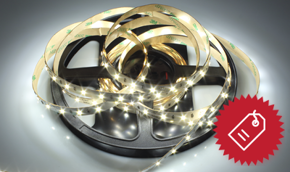
If floodlight projectors cover the primary illumination of the racing surface, high-power led strips find use in a series of specific applications that contribute to the safety, functionality, and overall aesthetics of the track facility. These applications require products with precise technical characteristics (IP protection rating, power per meter, color temperature, CRI) selectable with great precision thanks to the extraordinary variety of the Ledpoint catalog.
Perimeter lighting and track delimitation
Perimeter track lighting with led strips integrated into guardrails, curbs, lateral delimiters, or safety profiles serves to make the track edge visible even in conditions of poor residual illumination or during emergency transitions. This application requires led strips with:
- IP65 or higher protection rating: exposure to dust, water, chemical agents from lubricants and fuels (in motorsport tracks);
- Mechanical resistance IK: strips positioned near the racing surface must withstand object projections and accidental impacts;
- Color temperature: cool white 6000-6500K or amber/orange for safety zones, according to facility signage conventions;
- Sufficient power: strips from 14.4–24 W/m to ensure visibility even with partial dust or dirt coverage.
Lighting for pit areas and pit-lanes
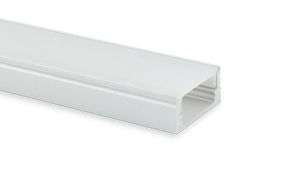
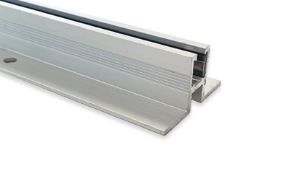
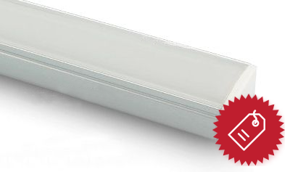
In karting and motorsport tracks, pit areas and the pit-lane require elevated illuminance levels (200-500 lux) to enable rapid vehicle maintenance operations during races and technical inspections. High-density led strips mounted on aluminum profiles inside pits ensure uniform, quality light (CRI ≥ 90 recommended for technical verification of livery colors), without pronounced shadows and with neutral color temperature (4000-5000K) facilitating mechanics' work.
Led strips with 120 leds/m or 240 leds/m mounted in aluminum profiles with diffused cover are the ideal solution for this application: they provide continuous light without dot pattern, uniformly distributed across the entire pit surface without shadow zones between light points.
Luminous signage with RGB led strips
RGB and RGBW led strips find very specific use in sports track lighting: chromatic luminous signage for communicating messages to athletes and drivers during races (colored flags, emergency signals, position indicators). On karting tracks in particular, integration of RGB led strips into guardrails or along the pit lane enables replication of the traditional flag signaling system with much more visible light signals manageable remotely via DMX or WiFi controllers.
Accent lighting for grandstands and accesses
Grandstands, spectator access routes, bleachers, and corridors of track facilities benefit from lighting with led strips integrated into aluminum profiles: step lighting for spectator safety, accent lighting on grandstand metal structures, illumination of space under seats for evacuation route visibility. For these applications, warm white LED strips 2700-3000K with CRI ≥ 80 create a welcoming atmosphere that pleasantly contrasts with the cooler, more functional light of the track.
Lighting for support infrastructure: paddocks, workshops, control points
The track facility is not just the track: paddocks, team workshops, technical control points, ambulance stations, press rooms, and hospitality zones are part of a complex lighting ecosystem where led strips find capillary application. COB led strips, with Chip-On-Board technology, are particularly suitable for lighting workshops and paddocks where high color rendering (Ra ≥ 90) is necessary for technical vehicle inspection operations, and where the continuous light effect without dot pattern lends the environment a professional and sophisticated appearance.
Ledpoint products for track lighting
Our catalog offers a range of led strips, drivers, controllers, and accessories that, combined with appropriate floodlight projectors, enable the setup of complete, efficient, and regulation-compliant track lighting systems. Below is a reasoned selection of the most relevant products for this application.
High-power led strips for outdoor and track applications
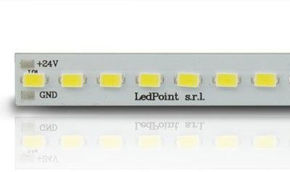
For perimeter, signage, and safety applications on tracks, Ledpoint led strips from the FE2 and F52 series, available in all color temperatures and in versions with IP65 protection rating, are the reference choice. The fundamental characteristics to specify for a track application are:
| Track application | Recommended power | Recommended CCT | CRI | IP | Led Density/m |
|---|---|---|---|---|---|
| Track perimeter delimitation | 14.4–19.2 W/m | 5000-6500K (cool white) | Ra ≥ 80 | IP65 | 120–240 |
| Guardrail / curb lighting | 9.6–14.4 W/m | 2700-3000K or color | Ra ≥ 80 | IP65 | 60–120 |
| Pit areas / pit-lane | 14.4–24 W/m | 4000-5000K | Ra ≥ 90 | IP20–IP44 | 120–240 |
| Bleacher and grandstand lighting | 4.8–9.6 W/m | 2700-3000K | Ra ≥ 80 | IP44 | 60–120 |
| RGB luminous signage | 7.2–14.4 W/m | RGB / RGBW | — | IP65 | 60–120 |
| Paddock and workshop lighting | 14.4–24 W/m (COB) | 4000-5000K | Ra ≥ 90 | IP20 | COB / 240 |
24V and 48V led strips: advantages on tracks
For track applications, where led strip run lengths can be significant (up to 10-15 m in a single run without intermediate power supply), the choice of supply voltage is fundamental. 24V led strips allow runs up to 10 m with acceptable voltage drop, while 48V led strips achieve runs of 15-20 m with a single driver, reducing the number of power supply points needed along the track perimeter, a huge advantage both in terms of installation costs and system reliability over time.
COB led strips: excellence for technical areas
COB LED strips (Chip-On-Board) represent the top tier for applications requiring continuous light without dot pattern effect, high CRI, and absolute uniformity: they are the ideal choice for team workshops in paddocks, for lighting technical inspection areas, and for all spaces where mechanics must precisely evaluate vehicle component color and condition. COB technology, with thousands of chips integrated directly onto the substrate without individual housing, guarantees maximum density of emitting points per linear millimeter and color rendering easily reaching Ra 95+ in premium versions.
Neon flex and flexible led tubes for signage
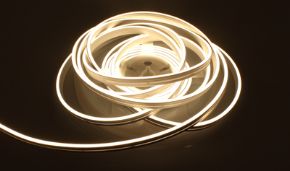
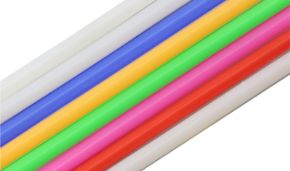
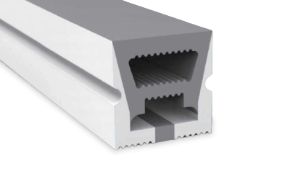
Neon flex and flexible led tubes find use in track luminous signage: visual delimitation of safety zones, indication of first aid points, signaling of evacuation routes, and decorative lighting of structures. Their flexibility makes them adaptable to curved surfaces, guardrails, handrails, and irregularly shaped structures that would be difficult to illuminate with rigid profiles.
Drivers and control systems for track facilities
The quality of electrical power supply for led strips is decisive for the quality of light produced and the longevity of components. For track facilities, where lighting systems operate daily for many hours in often challenging environmental conditions (temperature, humidity, vibrations), driver selection is even more critical than in standard residential or commercial applications.
Driver requirements for sports track applications
A driver for led track systems must satisfy technical requirements superior to those of a residential-use driver:
- certified power: nominal power must correspond to actual power, without derating under high temperature conditions;
- high efficiency: efficiency ≥ 90% to limit heat dissipation within the enclosure, especially in enclosed environments like pit electrical panels;
- power factor (PF) ≥ 0.95: requirement often imposed by electrical grid operators in medium-to-high power facilities;
- low ripple level: ripple (residual output voltage fluctuation) is directly correlated to LED strip flicker; a driver with ripple ≤ 150 mVpp guarantees practically flicker-free lighting;
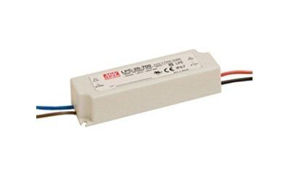
- integrated protections: overload, short-circuit, overvoltage, and overtemperature protection are minimum requirements for professional applications;
- Adequate IP protection rating: drivers positioned outdoors or in humid environments must have at least IP65.
Control and dimming systems for sports tracks
Dynamic lighting management is an increasingly requested requirement in modern track facilities. Control systems enable professional management of all led strips and led bars installed in the facility.
| Control protocol | Characteristics | Track application |
|---|---|---|
| 0-10V | Analog signal, wide compatibility | Linear dimming of perimeter systems |
| PWM | High precision, no efficiency loss | Precise control of high-density strips in pits |
| DALI/DALI-2 | Digital control, individual addressing | Complex scenario management, energy auditing |
| DMX/SPI | Professional control, RGB and dynamic | Chromatic signage, RGB effects on grandstands |
| WiFi / Zigbee | Wireless control, home automation integration | Remote on/off, timers, scenarios |
Photometric design of an led track system
Photometric design is the most delicate technical phase of the entire track lighting project. This is not an improvisable activity: it requires dedicated software tools, certified photometric data for products (IES/LDT files), knowledge of reference regulations, and interpretive capacity for results obtained from simulation. In this section we illustrate the step-by-step process that a professional designer follows to properly size an led track system.
Collection of input data
Before any calculation, it is necessary to gather all project input data: track layout with precise dimensions, available heights for projector installation (ceiling clearance for indoor, available pole heights for outdoor), anticipated competition level (Class I, II, or III per UNI EN 12193), any presence of grandstands with spectators and related viewing directions, television broadcast requirements (vertical illuminance, uniformity on vertical planes), and available budget for the system.
Calculation of total required luminous flux
The total luminous flux required to achieve the target illuminance value is calculated using the flux method:
Φ total (lm) = E target average (lux) × A track surface area (m²) / (UF × MF)
Where UF (Utilization Factor) is typically 0.3–0.5 for outdoor tracks illuminated by lateral poles, and MF (Maintenance Factor) is typically 0.75–0.80 for led systems with scheduled maintenance.
Practical example: outdoor athletics track, Class II, 400 m track (included inner surface ~100 m × 73 m = 7,300 m²), target 200 lux. Required flux: 200 × 7,300 / (0.40 × 0.80) = 4,562,500 lm. With 600W led projectors at 150 lm/W (90,000 lm each) and utilization factor 0.40: approximately 52 projectors are needed, distributed across 4-6 perimeter light towers. This is a rough estimate: the definitive project must be verified with software photometric simulation.
Simulation software: DIALux and relux
The two reference software tools for professional photometric simulation are DIALux evo (free, developed by DIAL GmbH) and Relux (paid, with educational version). Both allow importing IES or LDT photometric files for led projectors, modeling track geometry in 3D, calculating illuminance distribution across the entire point grid, and verifying UNI EN 12193 parameters (average lux, uniformity Uo, GR) directly in the project report. Photometric simulation is an indispensable tool for any track facility intended for official competitions and is required as mandatory documentation by major sports federation regulations for facility certification.
Calculation of led strips for perimeter applications
For led strips installed in track perimeter profiles, calculation is simpler. The required luminous flux per linear meter (lm/m) to achieve desired illuminance at observation distance is determined, verifying from Ledpoint strip technical data that the selected strip delivers that flux per meter. The lm/m data are reported in the technical datasheets of all Ledpoint catalog products and enable precise, documented selection.
Specific applications: karting, athletics, velodrome, motorsport
Each type of track facility has specific characteristics that translate into different design choices and led products. In this section we analyze the four main categories with practical guidance and references to the Ledpoint products most suitable for each.
Indoor karting tracks
The indoor karting track is the most widespread track facility in the recreational segment and one of the most challenging from a lighting perspective due to the combination of relatively low spaces (ceiling at 6-10 m), tortuous layouts with tight curves, and the simultaneous presence of drivers of all ages with varying experience levels and visual capabilities.
The typical lighting layout provides for 100-300W led projectors mounted on beams or metal ceiling structures with 4-6 m spacing along the entire track length, complemented by IP65 led strips on lateral guardrails for perimeter delimitation and RGB luminous signage at pit-entry points and starting lights. Total installed power for an indoor karting track of approximately 1,000 m² typically ranges between 15 and 30 kW for an average illuminance level of 150-200 lux, depending on the efficiency of chosen projectors.
Athletics tracks
The outdoor athletics track of 400 m is the most standardized facility: its oval geometry with eight lanes and fixed dimensions (176.91 m on straight, curves with typical inner radius of 36.5 m) enable development of standard lighting layouts that can be adapted to the required competition level primarily by varying pole height and projector power.
Critical points of athletics track lighting are: the 100 m straights (where risk of direct glare is greatest), throwing event starting zones (where athletes raise head and arms overhead with risk of fixating overhead sources), and the curve where runners look toward the stadium interior (where projectors positioned on internal grandstands could cause glare). The solution preferred by lighting designers for Class II and III outdoor tracks is lateral poles at height 12-16 m, positioned outside the outer lane with asymmetric optics oriented toward the track surface.
Velodromes: indoor and outdoor
The velodrome is a facility with extreme geometric characteristics: the track has banked curves of 45° in high-competition indoor versions, with inner radii of 25-28 m and surfaces of Belgian pine or Finnish spruce wood. Lighting for a modern indoor velodrome must guarantee CRI Ra ≥ 80 (preferably Ra ≥ 90) for correct perception of the wooden surface and cyclist liveries, uniformity Uo ≥ 0.7 for Class II, and GR ≤ 50 with special care for banked curve zones where cyclists look obliquely toward the ceiling during high-speed races.
Integration of high-CRI COB led strips in supplementary lighting for corridors and spectator areas of the velodrome completes the main system with floodlight projectors, creating a coherent, professional-quality luminous environment.
Motorsport circuits and racing tracks
Lighting for automobile racing circuits for evening or nighttime events is the most complex case study in the entire track lighting field: high speeds, long tracks from 2 to over 5 km, complex infrastructure (pit building, control tower, press structures), and broadcast requirements for ultra-high-definition television coverage. In these contexts, the Ledpoint led strip component focuses on detail applications: lighting of pit-lanes, team boxes, race control tower, spectator accesses, and luminous signage along the track.
Addressable RGB led strips find spectacular application in lighting common spaces and grandstands of modern circuits, where light shows synchronized with music and on-track events are part of the audience experience. Controlled via SPI master and DMX management software, these strips enable high-impact luminous animation effects that enrich the event atmosphere without interfering with the technical requirements of track illumination.
Energy savings and ROI of led track lighting
Investment in an led track lighting system is justified not only by superior light quality and regulatory compliance, but also on strictly economic grounds. Calculating the return on investment (ROI) of an led retrofit versus a traditional system with metal halides or high-pressure sodium is an exercise that clearly highlights the economic advantages of led in the medium and long term.
Energy savings calculation
The energy savings achievable with an led retrofit of a traditional track system depends on the efficiency of replaced sources and that of new led sources. As a practical reference: replacing 40 projectors of 600W (metal halides) with 40 led projectors of 300W at the same photometric quality (thanks to led's superior efficiency) reduces installed power from 24 kW to 12 kW, with 50% energy savings per hour of operation.
| Example facility | Traditional technology | Led technology | Energy savings |
|---|---|---|---|
| Outdoor athletics track, 40 projectors | 40 × 600W = 24 kW | 40 × 300W = 12 kW | 50% |
| Indoor karting, 60 projectors | 60 × 250W = 15 kW | 60 × 100W = 6 kW | 60% |
| Indoor velodrome, 80 projectors | 80 × 400W = 32 kW | 80 × 160W = 12.8 kW | 60% |
Maintenance savings
Maintenance savings are often underestimated in ROI calculation, but are one of the most relevant economic factors for track facilities. With LED useful life exceeding 50,000 hours, a properly sized system requires no lamp replacement interventions for 10-15 years. Considering that each intervention on projectors at 12-20 m height requires a truck with aerial platform at a cost of 500-1,500 euros per workday, the cumulative maintenance savings over the LED system's life is easily on the order of tens of thousands of euros even for medium-sized facilities.
Payback period: when the investment is recovered
The payback period (investment recovery period) for an LED retrofit of a track facility is typically between 3 and 6 years, depending on annual operating hours, electricity cost, and initial investment cost. Facilities with many operating hours (indoor tracks open to the public 8-12 hours per day) present shorter payback periods, sometimes under 3 years.
Below we attempt to briefly answer the questions most frequently asked when addressing this topic. According to the UNI EN 12193:2019 standard and CONI guidelines, an athletics track requires a minimum average horizontal illuminance of at least 75 lux for Class III (training and amateur use), 200 lux for Class II (national competitions), and 500 lux or more for Class I with television broadcasts. The minimum recommended CRI is Ra ≥ 65, with Ra ≥ 80 for facilities with television broadcasts. For nighttime or indoor use of a go-kart track, industry practice provides for a minimum illuminance of 100 to 200 lux on ground, with variation between minimum and maximum not exceeding 10% to ensure uniformity. For certified competition tracks it is necessary to achieve higher values, with UNI EN 12193 Class II criteria (300-500 lux). The reference standard is UNI EN 12193:2019 "Light and lighting, Lighting of sports installations". It defines minimum illuminance values (lux), uniformity, glare limitation (GR and UGR), and chromatic properties of sources. In Italy, CONI expressly references this standard in its guidelines for sports facilities. Glare is measured with the GR (Glare Rating) index for outdoor facilities and with the UGR index for indoor facilities. On racing tracks, glare control in the direction of the finish line and in curves where drivers look directly toward sources is particularly critical. The standard sets maximum permissible values for each discipline and lighting class. Yes. High-power led strips (14.4–24 W/m and above) with IP65 or higher protection rating find application in perimeter and signage lighting of tracks, in pit areas, in pit-lanes, in grandstand lighting, and in paddocks. For primary illumination of the racing surface, high-power led floodlight projectors are instead required. Flicker-free indicates absence of flicker in emitted light, detectable both by the human eye and by high-speed acquisition cameras and video cameras. In contexts of television broadcast of races, flicker can produce visible bands or pulsations in video. Ledpoint led systems with certified quality drivers eliminate this problem. Ledpoint led strips are certified IEC/TR 62778 Photobiological Risk Group 1. The standard does not specify color temperature for sports tracks. Generally, 4000-5000K (neutral white and cool white) is the most widespread choice for outdoor tracks and technical sports environments: it renders natural colors, enhances racing surfaces (red of athletics tartan, gray of circuit asphalt, wood of velodrome), and ensures excellent perception of chromatic contrasts. For spectator areas and paddocks, warmer white (3000-3500K) is preferred to create a more welcoming atmosphere. The cost of a complete led system for an outdoor athletics track depends on many factors: facility size, target competition level, need for civil infrastructure (pole foundations, conduits), and condition of existing electrical system. As an indicative order of magnitude, an outdoor Class III athletics track without poles (to be installed new) requires an overall investment on the order of 50,000-150,000 euros for the LED lighting portion alone, with significant reduction in case of retrofit of existing facility where poles and electrical infrastructure are already present. For LED strips installed on long track perimeters, choosing 24V or 48V ensures longer runs without voltage drop compared to 12V. Ledpoint 48V led strips allow runs up to 15-20 m with a single driver, reducing the number of power supply points needed along the perimeter, a significant advantage for system simplicity and long-term reliability. Selection of floodlight projectors for a sports track requires professional photometric design with DIALux or Relux software, using certified IES/LDT photometric files for products.FAQ: your most frequent questions about track lighting
Track lighting: a challenging project
Led track lighting, understood as lighting for sports racing tracks, karting circuits, velodromes, and athletics tracks, is one of the most demanding and technically challenging applications in the entire field of professional lighting. It requires knowledge of specific regulations (UNI EN 12193:2019, CONI guidelines, federation prescriptions), rigorous photometric design with professional simulation tools, accurate selection of products with the right technical characteristics for each facility zone, and the ability to integrate different sources (floodlight projectors, led strips, light bars, control systems) into a coherent and high-performing system.
The quality of light on a sports track is first and foremost a matter of safety, and then of athletic performance and spectacle. Choosing the right components and designing the system with due precision means contributing directly to athlete safety and to the quality of events that facility will host for the next 15-20 years.