






What are aluminum profiles for LEDs used for?
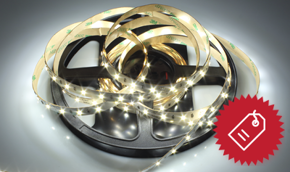
One of the most frequently asked questions we receive concerns the purpose of aluminum profiles for LED strips. Often, users contacting our technical support department—after damaging an LED strip installed on unsuitable surfaces—ask whether simply sticking the strip in place is sufficient. Unfortunately, the answer is always no. In this article, we will explain why, supporting our claims with full technical data. Skipping the profile to save money actually doubles costs—not only in components but also in time and labor.
What are aluminum profiles for led strips (led channels)?
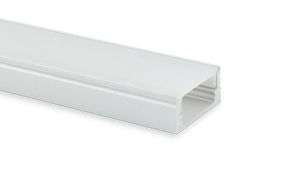
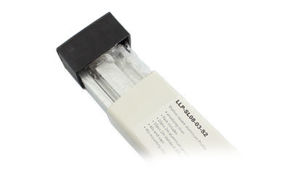
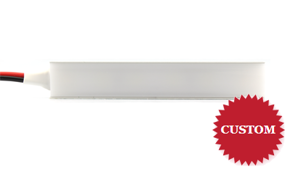
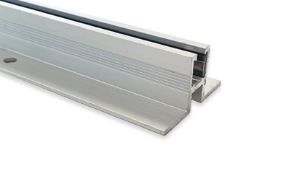
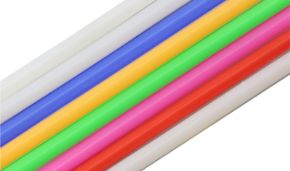
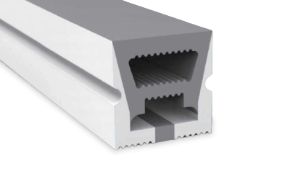
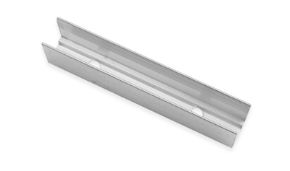
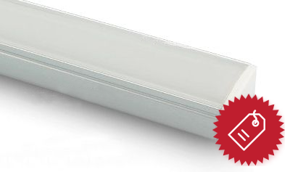
An aluminum profile for LED strips (also called a channel, extrusion, or track) is essentially a long, slim guide made of extruded aluminum, designed to house an LED strip. It consists of a main body (visible or recessed) and a PC (polycarbonate) or PMMA (acrylic) diffuser that clips on top to evenly distribute light and protect the LEDs. Depending on installation needs and environment, numerous types are available: recessed, surface-mounted, gypsum board-compatible, and more.
5 Reasons why aluminum profiles for led strips are essential
There are multiple reasons why LED strips should never be installed without aluminum profiles—the most critical being thermal management of the heat they generate.
1. Heat dissipation: the lifespan of an led strip depends primarily on this
This is the most important—and most underestimated—factor. LEDs generate heat, especially high-brightness models or those driven at maximum power. Heat is the number-one enemy of LED diodes. Without adequate cooling, junction temperature rises, light output becomes less efficient (lumens/watt drops), and lifespan plummets dramatically.
Aluminum is an excellent thermal conductor: the profile acts as a passive heatsink, absorbing heat from the strip and dissipating it into the environment via its large surface area. Performance varies significantly across mounting surfaces, as shown in the table below—compiled from tests by our technical lab and industry studies:
| Configuration | Approx. led junction temperature | Estimated lumen maintenance (L70)* | Notes |
|---|---|---|---|
| Adhesive LED strip mounted on wood | > 95°C | 10,000 – 15,000 hours | Premature degradation, possible color shift |
| LED strip installed in aluminum profile (no thermal paste) | ~ 75°C | 15,000 – 30,000 hours | Significant improvement |
| LED strip + thermal paste + quality aluminum profile (e.g., our models, thickness ≥1.2 mm) | ~ 55°C | > 30,000 hours | Optimal conditions, maximized lifespan |
*L70 indicates hours until luminous flux drops to 70% of initial value—the industry standard for defining LED "lifespan."
Using an aluminum profile today means avoiding full replacement in two years due to burnt-out strips. Always consider strip type and installation environment when selecting components.
2. Light quality and visual comfort
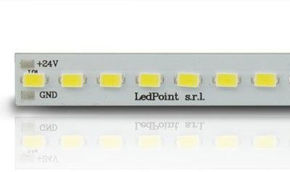
An undiffused LED strip appears as a series of intensely bright dots. Viewing it directly causes discomfort and glare (discomfort glare). Aluminum profiles with opal diffusers transform these dots into a continuous, uniform, and pleasant line of light, eliminating the "dot effect" and ensuring homogeneous diffusion.
Diffuser choice matters—options include:
- Clear: maximum efficiency, but LEDs remain visible;
- Opal: most common option; optimal balance between efficiency (~10–15% loss) and perfect uniformity;
- Micro-prismatic: ultra-uniform diffusion with controlled beam angle—ideal for accent lighting on objects.
Profile selection also defines final aesthetics: a flush-mounted recessed profile creates a minimalist, integrated look; a suspended profile becomes a design element. Without a profile, installations appear incomplete or amateurish.
3. Mechanical and environmental protection
LED strips are delicate—SMD components are vulnerable to impacts, scratches, dust, and moisture. Aluminum profiles provide three-tier protection:
- Physical protection: shields LEDs and circuits from direct impact;
- Dust and insect resistance: diffusers seal the LED compartment;
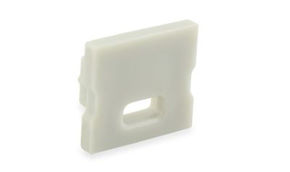
- Moisture protection (IP rating): complete kits (profile + end caps + diffuser) achieve IP65 or higher, making them suitable for kitchens, bathrooms, and select outdoor applications (e.g., under eaves). Even "waterproof" strips lack the comprehensive protection of a fully enclosed system.
Result: fewer failures, less maintenance, and lasting visual perfection.
4. Professional installation made simple
Trying to mount 5 meters of LED strip straight on a wall—especially on imperfect surfaces—quickly proves frustrating and imprecise. Adhesive backing may lose grip; the strip bends or misaligns.
Profiles solve this:
- Securely mount the profile once (using screws, clips, or silicone);
- Insert the LED strip into the channel—often aided by pre-applied adhesive tape inside the profile;
- Clip the diffuser neatly on top.
The result: a perfectly straight, stable, clean light line with no waviness or lifting edges. Many profiles also include cable management channels for a truly polished finish. For professionals, profiles save installation time and guarantee client-satisfying results.
5. Aesthetic versatility and adaptability
Today, lighting is no longer purely functional—it’s integral to architecture and interior design. Aluminum LED profiles adapt light to any shape, context, or style.
That’s why we offer such a wide range:
| Type | Application | Advantage |
|---|---|---|
| Recessed | Ceilings, kitchen cabinets, stairs, furniture | Invisible light effect, seamless integration, minimalist |
| Corner | Sinks, niches, displays, architectural contours | Perfect 90° corner illumination; easy installation in tight spaces |
| Flexible | Curved architecture, organic shapes, 3D lettering | Hand-bendable to follow any curve (radius ≥ 5 cm) |
| Stair profile (stair profile) | Stair risers, skirting boards | Robust design, anti-slip feature integrated into diffuser |
This versatility is impossible to achieve with bare strips. Profiles give light shape, purpose, and design intent.
Why choose aluminum profiles for led strips?
Summary of the 5 key benefits:
- maximum longevity: superior thermal dissipation = LEDs lasting 2–3× longer;
- professional light quality: zero glare, uniform continuous illumination;
- total protection: shield against impacts, dust, and moisture;
- flawless installation: straight, clean, stable results with minimal effort;
- limitless design: multiple solutions to integrate light into any space.
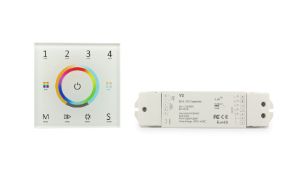
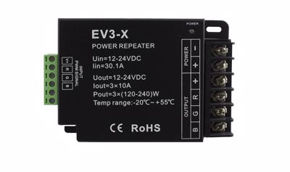
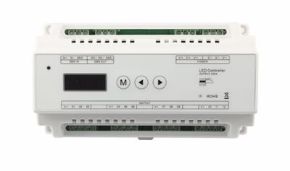
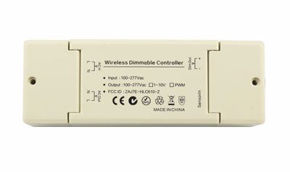
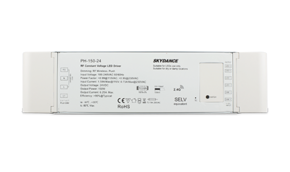
Investing in a complete lighting system—profile + strip + driver + controller—is the only way to achieve professional, durable, and visually striking LED illumination.
Frequently asked questions
Q: "Does the profile get hot?"
A: Yes—and that confirms its effectiveness! If it warms up, it’s transferring heat from the LEDs to the air. A cold profile with LEDs on indicates poor thermal conduction.
Q: "Can I cut the profile myself?"
A: Absolutely. Aluminum cuts easily with a hacksaw or metal-cutting blade.
Q: "Which profile do you recommend for…?"
A: This is our most common question—which is why our sales and technical teams are here to help. Contact us!
Aluminum profiles for led strips: it’s time to make the smart choice!
After addressing the most common doubts about aluminum profiles for LED strips, we hope it’s clear: the profile is essential—it’s the foundation of a quality LED installation. Skipping it to save money is like building a house without foundations: structural issues arise quickly, costing far more than the initial "savings."
If you have any questions about product selection or installation, please contact us. If you already know what you need, start exploring all LED profiles available at Ledpoint.it →
Sources and references
Technical data and claims in this article are based on:
- Internal Ledpoint tests conducted in thermal chambers
- IES LM-80 and TM-21 standards for LED lumen maintenance measurement
- "Thermal Management for LED Applications" by M. Arik, J. Petroski, S. Weaver (IEEE Components and Packaging Technologies)
- Technical guidelines from premium LED manufacturers (Nichia, Seoul Semiconductor, Cree)
- IEC 60598 standard (Safety of Luminaires) and IEC 62471 (Photobiological Safety)
Note: L70 lifespan values are estimates under optimal operating conditions. Actual results may vary based on environmental factors, driver quality, and correct system sizing.